

2011-11-30


2011-11-19

2011-11-16
Knowledge behind paywalls and glass doors
People want to know things (biased or unbiased). This quest over time led to the development of what we call: science, the systematic enterprise that build and organizes knowledge (according to wikipedia).
The 19th century 'scientist' was a man with enough wealth (or his family's wealth or to paid by a very wealthy individual) to support their hobbies. This process, facilitated by discussion of Charles Babbage, John Herschel, Williamn Whewell, and Richard Jones (as described in The Philosophical Breakfast Club by Laura Snyder), was transformed into a profession with career paths and guidelines of sorts. Now anyone could go to university and be trained to become a scientist. If you that: Welcome to the academic rat race.
For your work to be acknowledged and appreciated by your peers, you have to publish your work. Where do you publish? If you are in the field of biological sciences, you want to publish in journals with high impact factors (as calculated by Thomson Reuters Corporation), such as Science, Nature or Cell.
So how does this process work?
It all boils down to who is paying at the end of the day (hint: are you paying taxes?):
1. you do your experiments and write a manuscript of your results
2. you submit your manuscript to a journal
3. your peers review this manuscript as quality control for free (after the editors of the journal deemed the research presented in the manuscript innovative enough)
4. if accepted, you pay a fee to publish
5. for your peers to read your work, their universities need to have a subscription to that specific journal.
In steps 1, 3, and 5 the funding that supports your research is paying for this and in most cases researchers are funded with state or federal funds. Thus, the taxpayers are indirectly paying for this. In addition to cashing in on federal funding, publishing companies will also demand full copyright on all work published under their banner. In other words, they claim legal ownership of this work, of this knowledge. All of that without having done a single experiments. Without having analysed any data. Without having thought how this data fits in the current body of knowledge. Without having written any article describing primary research. And as a courtesy to everyone, they demand that everyone pays them to read the body of work they have not intellectually contributed to in any form. Intellectual and experimental contribution are a pre-requisite to be a co-author on a particular paper. Yet, the authors give up the legal ownership of their own work, yet pride themselves for doing so and showcase this where ever they go to give a talk (their own work that is). This means that the libraries of universities and research institutes pay these publishers large sums of money (up to 65%) to have access to the articles that in part have been produced by the very same researchers who are affiliated to these universities and research institutions. The circle has been completed. The operating profit margin publishers make (36% in case of Elsevier) is nearly completely funded by the taxpayers.
What are the consequences of this system?
From a resource perspective, only the wealthiest universities can afford to pay for most of the available journal prescriptions. This means that there is a knowledge resource gap between the wealthiest universities versus a relatively poor college. For a researcher at a 'poor' college it will be much harder to stay up to date with his/her field compared to his/her peers at one of the wealthier universities/institutions.
This means that the wealthiest universities have the capacity to do great review work of the currently available knowledge on any given subject, yet this rarely happens. This can be contributed to the peer pressure to publish novel research in top tier journals. With these publications in top tier journals the researcher has a greater chance of getting funding, as well as maintaining on the path to become a tenured professor (the holy grail of the academic researcher). Even in a more junior position, like if you want to get a good post-doc position, publications in a top tier journal greatly helps your cause. So, to be a competitive researcher you are forced through peer pressure and institutionalized bureaucratic guidelines to publish in journals that are run by publishers that greatly (albeit indirectly) profit from federal tax-money.
What about a researcher in a developing country?
In developing countries this problem is even bigger. First off, there is less money to do research. Second, getting supplies to do expensive experiments are hard to get and nearly always come with long delivery times. Third, it is hard for these researchers to keep up with literature because of above mentioned reasons, but also because of visa issues to attend meetings in the Western world. The WHO, in part, tried to accommodate this by creating HINARI, a program that gives access to ~8000 journals to researchers in developing countries (but only a select group of developing countries).
 Breaking this cycle will be difficult, as it is difficult to dismantle any established system. What can be done is breaking Open the Access to the literature. The very research funded by the people and
Make all published work openly accessible to anyone who would like to read it, no matter where this person lives, no matter the income or affiliation this person has, no matter the eduction this person has received. Everyone will be able to read the finding and claims of scientists without having to pay exorbitant amounts of money to companies who are currently claiming copyright ownership on knowledge being produced by people who are, by enlarge, being paid with federal or state money.
 The first steps have been taken by the creation of the Public Library of Science or PLoS. They promote OpenAccess and Creative Commons. The success of this movement is obvious, as the established publishers are now creating their own version of an OpenAccess journal. Even the three largest private funding agencies (Max Planck Institute, Welcome-Trust, and HHMI) are working together to create an OpenAccess journal. That is type of publishing is necessary has not been misunderstood by the developing countries, as Brazil has launched SciELO in 1997 (PLoS was founded in 2001). Slowly but steadily science is becoming an open endeavour for everyone to follow and thus creating public accountability for work done with public money.
The 19th century 'scientist' was a man with enough wealth (or his family's wealth or to paid by a very wealthy individual) to support their hobbies. This process, facilitated by discussion of Charles Babbage, John Herschel, Williamn Whewell, and Richard Jones (as described in The Philosophical Breakfast Club by Laura Snyder), was transformed into a profession with career paths and guidelines of sorts. Now anyone could go to university and be trained to become a scientist. If you that: Welcome to the academic rat race.
For your work to be acknowledged and appreciated by your peers, you have to publish your work. Where do you publish? If you are in the field of biological sciences, you want to publish in journals with high impact factors (as calculated by Thomson Reuters Corporation), such as Science, Nature or Cell.
So how does this process work?
It all boils down to who is paying at the end of the day (hint: are you paying taxes?):
1. you do your experiments and write a manuscript of your results
2. you submit your manuscript to a journal
3. your peers review this manuscript as quality control for free (after the editors of the journal deemed the research presented in the manuscript innovative enough)
4. if accepted, you pay a fee to publish
5. for your peers to read your work, their universities need to have a subscription to that specific journal.
In steps 1, 3, and 5 the funding that supports your research is paying for this and in most cases researchers are funded with state or federal funds. Thus, the taxpayers are indirectly paying for this. In addition to cashing in on federal funding, publishing companies will also demand full copyright on all work published under their banner. In other words, they claim legal ownership of this work, of this knowledge. All of that without having done a single experiments. Without having analysed any data. Without having thought how this data fits in the current body of knowledge. Without having written any article describing primary research. And as a courtesy to everyone, they demand that everyone pays them to read the body of work they have not intellectually contributed to in any form. Intellectual and experimental contribution are a pre-requisite to be a co-author on a particular paper. Yet, the authors give up the legal ownership of their own work, yet pride themselves for doing so and showcase this where ever they go to give a talk (their own work that is). This means that the libraries of universities and research institutes pay these publishers large sums of money (up to 65%) to have access to the articles that in part have been produced by the very same researchers who are affiliated to these universities and research institutions. The circle has been completed. The operating profit margin publishers make (36% in case of Elsevier) is nearly completely funded by the taxpayers.
What are the consequences of this system?
From a resource perspective, only the wealthiest universities can afford to pay for most of the available journal prescriptions. This means that there is a knowledge resource gap between the wealthiest universities versus a relatively poor college. For a researcher at a 'poor' college it will be much harder to stay up to date with his/her field compared to his/her peers at one of the wealthier universities/institutions.
This means that the wealthiest universities have the capacity to do great review work of the currently available knowledge on any given subject, yet this rarely happens. This can be contributed to the peer pressure to publish novel research in top tier journals. With these publications in top tier journals the researcher has a greater chance of getting funding, as well as maintaining on the path to become a tenured professor (the holy grail of the academic researcher). Even in a more junior position, like if you want to get a good post-doc position, publications in a top tier journal greatly helps your cause. So, to be a competitive researcher you are forced through peer pressure and institutionalized bureaucratic guidelines to publish in journals that are run by publishers that greatly (albeit indirectly) profit from federal tax-money.
What about a researcher in a developing country?
In developing countries this problem is even bigger. First off, there is less money to do research. Second, getting supplies to do expensive experiments are hard to get and nearly always come with long delivery times. Third, it is hard for these researchers to keep up with literature because of above mentioned reasons, but also because of visa issues to attend meetings in the Western world. The WHO, in part, tried to accommodate this by creating HINARI, a program that gives access to ~8000 journals to researchers in developing countries (but only a select group of developing countries).

Make all published work openly accessible to anyone who would like to read it, no matter where this person lives, no matter the income or affiliation this person has, no matter the eduction this person has received. Everyone will be able to read the finding and claims of scientists without having to pay exorbitant amounts of money to companies who are currently claiming copyright ownership on knowledge being produced by people who are, by enlarge, being paid with federal or state money.

Protists in the lime light (of a microscope)
Our world is much more diverse than just plants and animals or even bacteria. Have a look at this video highlighting some of the diversity of our fellow eukaryotes, the protists.
Microscopic Worlds - Life that we don't see from Daniel Stoupin on Vimeo.
2011-10-17
2011-10-01
US Grand Prix Formula 1 comes to Austin, TX with Red Bull
Lovely promotion video and I am sure that the mechanics were thrilled with all the dirt and gravel in the engine and the rest of the car.
2011-09-01
RevoLight - (almost) a new light-system for your bike
Jim, Kent and Adam from Palo Alto, CA came up with a new light-system for bikes. It looks very nice in their video, but I think it is also a major improvement over the currently existing bike-light systems (dynamo-driven light or LED-light on batteries). Have a look for yourself.
2011-08-16
Chewing gum. How to swallow it.
There are several things you can do with gum. You can make bubbles, stick underneath a desk or seat or even make art with it. But let's focus on the other end of your mouth for the moment. Let's swallow gum. When we were younger our parents would tell you not to swallow chewing gum, because it might obstruct your digestive tract. What kid has ever listened to their parents?
But how can you swallow chewing gum. There are several ways you can do this.
1) The obvious way, just swallow it like a pill.
2) While you enjoying your gum, take a bite of cookie. You will be surprised to notice that your gum is slowly disintegrating. How do I know this? Well, as any normal kid, I never had the patients to enjoy one candy at a time. Whenever my parents weren't around I would put a piece of gum in my mouth and on occasion after some time I would feel like a cookie. After a bite of the cookie and chewing the cookie a bit, I noticed that the chewing gum I was hiding in a different place in my mouth (so I could enjoy it after the cookie further) was slowly disintegrating or dissolving. Which ever it may be, it made NOT swallowing the gum a lot more difficult.
3) Leave your gum in the car under a backing sun, especially the long/flat shaped gum. The gum might be a bit stuck to its wrappings, but it will come off. Put it in your mouth and start chewing. At first the gum will behave normally, but after a minute or so, the gum will feel as it is dissolving in your saliva. It takes patience in chewing NOT to swallow the gum. The nice thing is, you will get a nice fresh breath more quickly this way. Again, I found this out by parking my car in the sun of Davis in the summer. If you use chewing gum with sugar, the effects of the heat are even more pronounced.
Why would you want to swallow your gum? I am not sure, but disintegrated/dissolved gum does taste just like mints.
But how can you swallow chewing gum. There are several ways you can do this.
1) The obvious way, just swallow it like a pill.
2) While you enjoying your gum, take a bite of cookie. You will be surprised to notice that your gum is slowly disintegrating. How do I know this? Well, as any normal kid, I never had the patients to enjoy one candy at a time. Whenever my parents weren't around I would put a piece of gum in my mouth and on occasion after some time I would feel like a cookie. After a bite of the cookie and chewing the cookie a bit, I noticed that the chewing gum I was hiding in a different place in my mouth (so I could enjoy it after the cookie further) was slowly disintegrating or dissolving. Which ever it may be, it made NOT swallowing the gum a lot more difficult.
3) Leave your gum in the car under a backing sun, especially the long/flat shaped gum. The gum might be a bit stuck to its wrappings, but it will come off. Put it in your mouth and start chewing. At first the gum will behave normally, but after a minute or so, the gum will feel as it is dissolving in your saliva. It takes patience in chewing NOT to swallow the gum. The nice thing is, you will get a nice fresh breath more quickly this way. Again, I found this out by parking my car in the sun of Davis in the summer. If you use chewing gum with sugar, the effects of the heat are even more pronounced.
Why would you want to swallow your gum? I am not sure, but disintegrated/dissolved gum does taste just like mints.
2011-08-06
The Netherlands - much more religious than you think
Let's start with a confession: yes! the Netherlands has a bible belt and it is prominent and has a continuous present in Dutch parliament. It is also the main group that resists to creates laws against criminalising psychological manipulation and exploitation, a feature that sects use on their followers. Let's look at some maps of the Netherlands. The 12 provinces of the Netherlands are shown in the first figure.
In short the main regions in the Netherlands are the 'Randstad', which is most of Zuid-Holland, the southern part of Noord-Holland and most of Utrecht. Or the square Amsterdam (Noord-Holland), Den Haag (Zuid-Holland), Rotterdam (Zuid-Holland) and Utrecht (Utrecht). The West is bit larger and entail the provinces Zeeland, Zuid-Holland, Noord-Holland and Utrecht. This is also historically the most influential region of the country. Then we have the South, which is the area below the rivers Rhine (Rijn) and Meuse (Maas) and are comprised of the provinces Noord-Brabant and Limburg. Finally we have the North, which are the provinces Fryslân (Friesland), Groningen and Drenthe. As you might have noticed, I did not mention the East or the provinces Gelderland and Overijssel or the completely man-made province Flevoland. The reason is that the East is rarely used a specific area in the Netherlands. Of course there are many smaller areas, such as the Achterhoek (most eastern part of Gelderland) and Betuwe (southern part of Gelderland between the rivers Rhine and Waal).
Calvin's version of Christianity caught on in what now is called the Netherlands, resulting in displacement of the Roman Catholic version of Christianity. This can be clearly seen in the Netherlands as the South is predominantly catholic (shown in green in Fig 2) and above the rivers people are predominantly protestant (shown in red in Fig 2).
This has not changed much over time as Figure 3 shows, with one major difference. The rise of self-proclaimed non-religious people (salmon pink colour in Fig 3). This is not to be confused with atheism or agnosticism, as many of these people do believe in some sort of higher supernatural power, but renounce organised religion.
But there is one thing that is striking in the Netherlands and that is the small communities that are deeply religious in a very extremist manner. In not a single community do they make up the majority, but their practises are peculiar in many different ways. In most cases the religious communities are split offs of the more moderate form of protestantism. Their distribution pattern runs from Zeeland to around Staphorst in Overijssel, creating a sort of a belt on a map: the Dutch Biblebelt.
 |
| Fig 1. The 12 Dutch provinces |
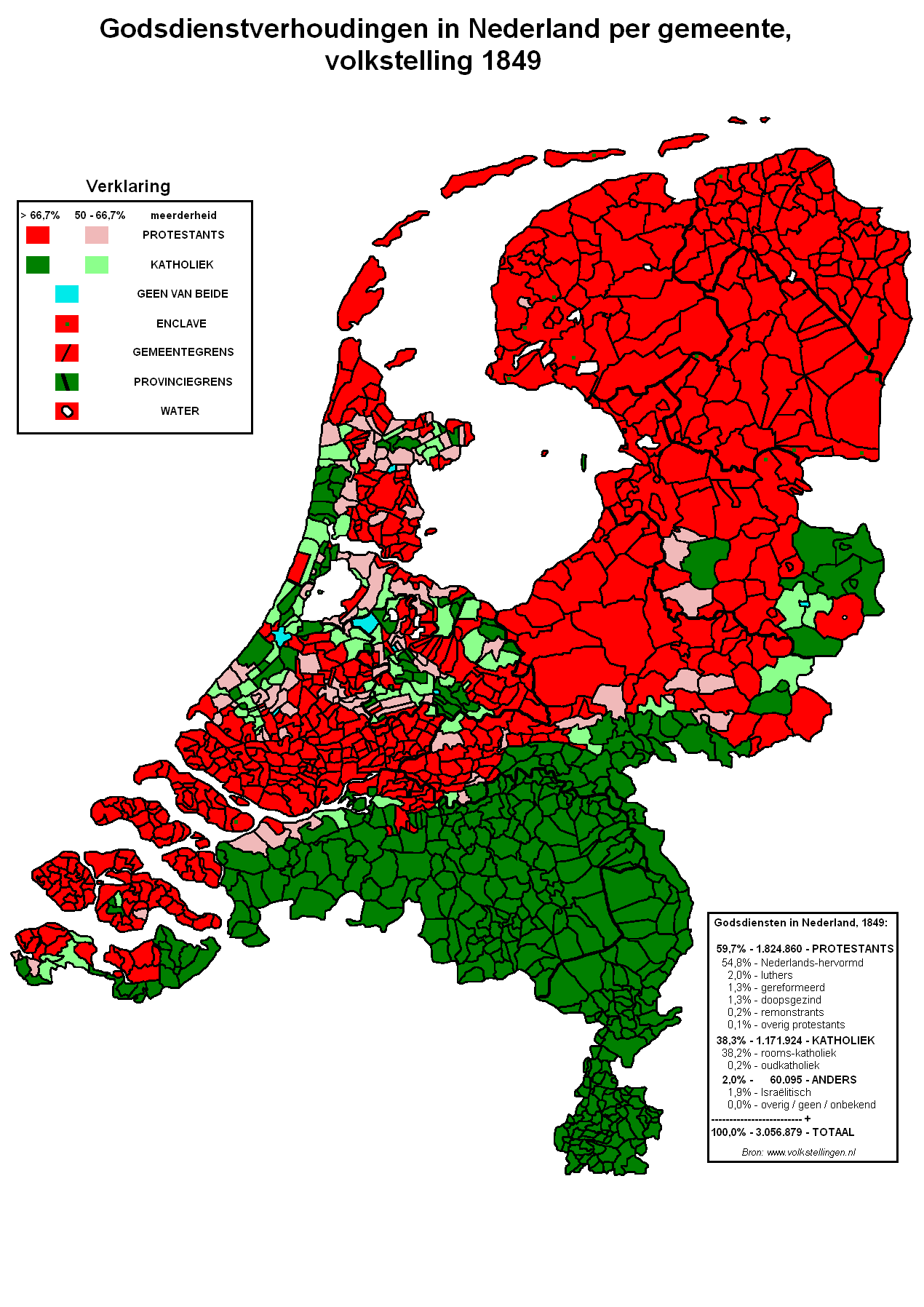 |
| Fig 2. Religious division in 1849 |
 |
| Fig 3. Current religious groups, including non-religious (!= atheist) |
 |
| Fig 4. In colour the extremely religious communities |
Their strength is clearly present in Dutch parliament by the SGP (Staatskundig Gereformeerde Partij or Political Reformed Party, where reformed refers to a type of protestantism), who have had about 2 of the 150 seats in parliament since 1918 and that number barely changes between elections. In other words, their voters are very loyal, their agenda very religious. These communities also refuse to vaccinate their children, because if they get a disease it is God's will. It is not surprising that the last person in the Netherlands to be diagnosed with polio was a kid from one of these communities, namely Streefkerk in 1992. Depending on the community, they don't pay taxes to the government or have insurances, as their loyalty is with God and not the state. They do pay large sums of their income to their respective churches. And on Sunday it is illegal to do anything as that is the day of the Lord and you must rest and go to church. In some communities is considered to be a sin to have televisions or radios or wear anything that might reveal some skin, especially on Sunday.
In summary, Dutch politics is not free from religious influence, which makes the Netherlands less secular than you might think. The consequences of making sect-like behaviours a criminal offence, especially psychological manipulation, very unlikely, as these Dutch bible-belt communities would have to be considered sects. No self-respecting politician in the Netherlands wants to burn their hands on these communities, even though none of them would ever vote for them anyway. A very strange relationship, indeed and it shows the power of well organised and financially able extremists groups.
2011-08-05
Colombia's gold rush - Fault Lines - Al Jazeera English
An interesting report on gold digging in Colombia. A country with many problems, but in the last decade it has made some impressive progress. Yet, gold and the position of gold in the global economy retains the power of creating problems. The larger an entity is, the more likely it seems to leach on the problem and exploit it. This is a great documentary in the Fault Lines series on Al Jazeera. Worth a watch beyond any doubt!
Colombia's gold rush - Fault Lines - Al Jazeera English
Colombia's gold rush - Fault Lines - Al Jazeera English
2011-08-04
Around world in 44 days or dancing
Some people take the world on. Save some money and go some places.
Recently 3 friends went for 44 days on a trip through 11 countries, requiring 18 flight, covering 38k miles. Not bad.
Then again, what if you take 14 months to travel to 42 countries and ask 1000s of people to dance with you. Crazy, right?
Anyone interested in providing funding for a trip around the world for 3? A crying/smiling baby in 45 countries, edited to 2m30s?
Recently 3 friends went for 44 days on a trip through 11 countries, requiring 18 flight, covering 38k miles. Not bad.
Then again, what if you take 14 months to travel to 42 countries and ask 1000s of people to dance with you. Crazy, right?
Anyone interested in providing funding for a trip around the world for 3? A crying/smiling baby in 45 countries, edited to 2m30s?
2011-08-03
Is speeding more dangerous than slowing?
Most of us will drive a car regularly and thus you will encounter fellow-motorists on the road. As I live about 100 km (~60 miles) from Davis, I have to commute to get to Davis. If only the train was affordable and reliable, I would use it, but it isn't. So I drive my relatively fuel-efficient Hyundai Elantra to-and-fro Davis. This means I encounter 100s of fellow-motorists on a daily basis. As I didn't grow up with California traffic, but with Dutch, German and Belgian traffic (ergo European road rules), I find myself both surprised and annoyed at the frequent and often pointless lane changes that my fellow-motorists make. Probably because my mind still tells me to stay right, unless I try to pass someone.
And I also did come by the CHP (California Highway Patrol) officer at one point. I was speeding, he told me. So he gave me a ticket for that.
This raises a question: is speeding really more dangerous then slowing (driver slower then the speed limit)?
The general consensus is that it is. Speeding is not only breaking the law, but also can cause serious harm. This is all true, but this does not mean that everyone who speeds is dangerous. In most cases it is the relative speed between you can your fellow-motorists that can make speeding dangerous. But rather then using logical reasoning alone, let's use some simple math.
Let say the speed limit is 100 kmh (~62 mph). To travel 100 km, it would take you 60m00s.
If you would 'speed' by 10%, you would be going at 110 kmh (~68 mph) and you would need about 54m32s to travel the same distance, a gain of 5m28s.
If you would 'slow' by 10%, you would be going at 90 kmh (~56 mph) and you would need about 66m40s to travel the same 100 km, a loss of 6m40s.
So time-wise, slowing has a more profound effect on time, then speeding. Often, the argument is made that because the time gain while speeding is limited, it is not worth it. Sporadically, if ever, the opposite argument is made.
But there is more to it then just time gain or loss, compared to the posted speed limit.
What effect does speeding have on time to respond vs slowing? How quick can someone who speeds respond to a situation, compared to someone who slows? In other words, can a car that slows speed up as quick as a car that speeds can slow down to the posted speed limit? Accelerating from 0 kmh to 100 kmh takes easily up to 10 seconds, whereas breaking from 100 kmh to 0 kmh requires about 120 meters or so. 10 seconds in a car covers more then 120 meters, so it would be fair to assume that slowing down takes less time then speeding up for the average driver.
Of course there is a lot more involved in driving a car, then just simply speeding or slowing or obeying the law (but who really does that on the road?). You rarely drive alone on the road, which means that you will encounter other vehicles who have to respond to what you are doing. Now let's take the consequences of speeding and slowing on the odds of having to deal with a fellow motorist. For this let's assume that everyone else is driving at the speed limit of 100 kmh. Slowing cars will encounter more fellow motorists then speeding cars. Now comes the crux. The slowing car has to either speed up to the average speed of 100 kmh or the fellow motorists have to pass the slowing car. The speeding car will encounter fewer fellow motorist, and has to either pass the fellow motorists or slow down to the average speed. If both the speeding car and the slowing car don't change their driving style, the slowing car will force fellow motorists to change behaviour to more people than the speeding car .
Here in California, CalTrans has made multilane highways and it is not uncommon to find 3 or 4 lane highways per driving direction. As in the USA people drive on the right, the natural tendency is to pass another motorist on the left. This means that slowing cars are presumed to stay in the right lane, whereas speeding cars tend to stay in the left lane. Now imagine that a slowing car moves 1 lane to the left. It will encounter even more fellow motorists and thus force more motorists to change driving behaviour. Often this result in fellow motorists slowing down for slowing cars, as the left lane is often already filled with other motorists. How do we know this is a realistic prediction. Look at the highways now and see what happens when a big-rig moves one lane over to pass a fellow big-rig. Yep, traffic will slow down.
So you might say: California has a law that says that slower traffic must stay right. True. But when was the last time you saw a CHP officer pull someone over for slowing? Yep, they pull over people who are speeding. Easy money over guaranteeing flow of traffic or traffic safety.
Then comes psychology. How do people respond to slowing cars over speeding cars. Well, if you are stuck behind a guy who thinks that the left lane is his lane, while going 70 kmh, you will get frustrated. Besides being under the influence of a restricted substance or mobile device or sleep deprivation, frustration is not very helpful in light of traffic safety. You are probably more likely to make an erratic move, while focussing on the slowing car in front of you. In other words, you are paying less attention to your fellow motorist. Not particularly safe if you ask me.
Are speeding cars more or less safe? Obviously, speeding cars who frequently change lanes and tail-gate are dangerous, but these drivers are most likely speeding more then 10%. But cars who drive above the speed limit in a limited manner are per se dangerous. They can lift the throttle and let the car role out to get back to the speed level of the car they are approaching.
The one group of drivers I have not mentioned: the speeding/slowing drivers. They combine the worst of two world for one of the most fundamental dangers on the road: unpredictability. This should be enforced by the police, but clearly they prefer to sit on the side of the road and just get a single moment event of a speeding car.
Maybe it would be worth fining people who drive a certain percentage above AND below the flow of traffic over a strict and set speed limit with a limited fluctuation of speed itself, unless you change lanes? This can be done by lane-specific speeds, with slower in the right lanes and faster in the left lanes. Is this tougher to enforce? Yes, but what is more important: traffic safety or being able to use the public for gathering enforcement 'tax'? Too bad we are currently in an economic recession, so we can only expect more speed-traps by the CHP. Of course this is all in the name of traffic safety and improving traffic flow.
And I also did come by the CHP (California Highway Patrol) officer at one point. I was speeding, he told me. So he gave me a ticket for that.
This raises a question: is speeding really more dangerous then slowing (driver slower then the speed limit)?
The general consensus is that it is. Speeding is not only breaking the law, but also can cause serious harm. This is all true, but this does not mean that everyone who speeds is dangerous. In most cases it is the relative speed between you can your fellow-motorists that can make speeding dangerous. But rather then using logical reasoning alone, let's use some simple math.
Let say the speed limit is 100 kmh (~62 mph). To travel 100 km, it would take you 60m00s.
If you would 'speed' by 10%, you would be going at 110 kmh (~68 mph) and you would need about 54m32s to travel the same distance, a gain of 5m28s.
If you would 'slow' by 10%, you would be going at 90 kmh (~56 mph) and you would need about 66m40s to travel the same 100 km, a loss of 6m40s.
So time-wise, slowing has a more profound effect on time, then speeding. Often, the argument is made that because the time gain while speeding is limited, it is not worth it. Sporadically, if ever, the opposite argument is made.
But there is more to it then just time gain or loss, compared to the posted speed limit.
What effect does speeding have on time to respond vs slowing? How quick can someone who speeds respond to a situation, compared to someone who slows? In other words, can a car that slows speed up as quick as a car that speeds can slow down to the posted speed limit? Accelerating from 0 kmh to 100 kmh takes easily up to 10 seconds, whereas breaking from 100 kmh to 0 kmh requires about 120 meters or so. 10 seconds in a car covers more then 120 meters, so it would be fair to assume that slowing down takes less time then speeding up for the average driver.
Of course there is a lot more involved in driving a car, then just simply speeding or slowing or obeying the law (but who really does that on the road?). You rarely drive alone on the road, which means that you will encounter other vehicles who have to respond to what you are doing. Now let's take the consequences of speeding and slowing on the odds of having to deal with a fellow motorist. For this let's assume that everyone else is driving at the speed limit of 100 kmh. Slowing cars will encounter more fellow motorists then speeding cars. Now comes the crux. The slowing car has to either speed up to the average speed of 100 kmh or the fellow motorists have to pass the slowing car. The speeding car will encounter fewer fellow motorist, and has to either pass the fellow motorists or slow down to the average speed. If both the speeding car and the slowing car don't change their driving style, the slowing car will force fellow motorists to change behaviour to more people than the speeding car .
Here in California, CalTrans has made multilane highways and it is not uncommon to find 3 or 4 lane highways per driving direction. As in the USA people drive on the right, the natural tendency is to pass another motorist on the left. This means that slowing cars are presumed to stay in the right lane, whereas speeding cars tend to stay in the left lane. Now imagine that a slowing car moves 1 lane to the left. It will encounter even more fellow motorists and thus force more motorists to change driving behaviour. Often this result in fellow motorists slowing down for slowing cars, as the left lane is often already filled with other motorists. How do we know this is a realistic prediction. Look at the highways now and see what happens when a big-rig moves one lane over to pass a fellow big-rig. Yep, traffic will slow down.
So you might say: California has a law that says that slower traffic must stay right. True. But when was the last time you saw a CHP officer pull someone over for slowing? Yep, they pull over people who are speeding. Easy money over guaranteeing flow of traffic or traffic safety.
Then comes psychology. How do people respond to slowing cars over speeding cars. Well, if you are stuck behind a guy who thinks that the left lane is his lane, while going 70 kmh, you will get frustrated. Besides being under the influence of a restricted substance or mobile device or sleep deprivation, frustration is not very helpful in light of traffic safety. You are probably more likely to make an erratic move, while focussing on the slowing car in front of you. In other words, you are paying less attention to your fellow motorist. Not particularly safe if you ask me.
Are speeding cars more or less safe? Obviously, speeding cars who frequently change lanes and tail-gate are dangerous, but these drivers are most likely speeding more then 10%. But cars who drive above the speed limit in a limited manner are per se dangerous. They can lift the throttle and let the car role out to get back to the speed level of the car they are approaching.
The one group of drivers I have not mentioned: the speeding/slowing drivers. They combine the worst of two world for one of the most fundamental dangers on the road: unpredictability. This should be enforced by the police, but clearly they prefer to sit on the side of the road and just get a single moment event of a speeding car.
Maybe it would be worth fining people who drive a certain percentage above AND below the flow of traffic over a strict and set speed limit with a limited fluctuation of speed itself, unless you change lanes? This can be done by lane-specific speeds, with slower in the right lanes and faster in the left lanes. Is this tougher to enforce? Yes, but what is more important: traffic safety or being able to use the public for gathering enforcement 'tax'? Too bad we are currently in an economic recession, so we can only expect more speed-traps by the CHP. Of course this is all in the name of traffic safety and improving traffic flow.
2011-08-02
The story of my sister's death (video in Dutch)
On December 8, 2009 my sister lost her life in Urmond. In record time the local police came to the conclusion she committed suicide. We are not convinced by their words alone and would like to see the evidence that support their conclusion, as we believe there are multiple facts that contradict the conclusion of the local police. In short, my sister supposedly stabbed herself three times in the chest in the presence of her boyfriend, following which she ran out of the house they lived in and collapsed and died less then 200 yards later. The police argues that she was 'psychotic', yet no clinical diagnosis was ever made. With help from the national newspaper De Telegraaf's Cold Case Team, a first review of the death of my sister was performed. This is the result as published in print and online last year as well as a video which can be found on youtube.
Subscribe to:
Posts (Atom)